 EN
EN

In the fast-paced world of business, the only sure bet is change. Businesses are scaling, technology is rapidly improving, and power requirements are becoming exponentially complicated. The ‘once upon a time standard’ static Uninterruptible Power Supply (UPS) systems are simply not keeping up, they are often overly supplied to start, resulting in a premature capital expense and wasted efficiency, or, the alternative undersupply, which calls for a completely new investment whenever a business powers up. That’s where we come into the equation, with the latest in scalable UPS systems – so if growth is planned for the future, you need not worry about planning for it when today you buy – it’s delivered to suit you. As data centers proliferate and the concept of ‘smart’ is applied more widely throughout industries, power protection through scalable UPS architecture is surely set to rise in the future.
Expand Power Capacity as Your Business Grows
Scalability One of the most compelling advantages to buying a scalable UPS unit is the idea of having the device scale with you. Where traditionally you had to predict future power needs up-front and buy a large, stand-alone unit or system built for a certain maximum draw, today you’re purchasing an infrastructure that’s built on the "pay as you grow" model.
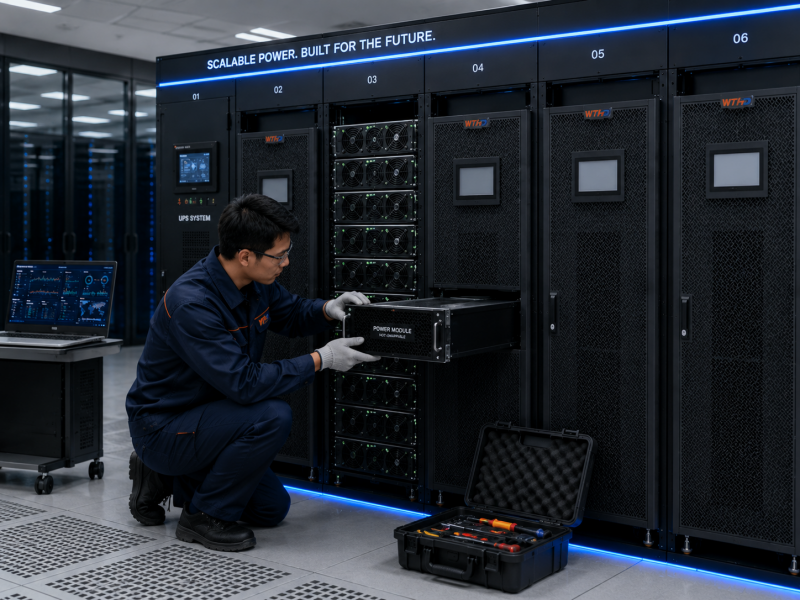
It’s basic, buy the capacity you need now, then whenever your business grows, slot new modules into the same infrastructure to bring it up to speed. This scalability is incredibly important when your business is expanding. A data center might buy and install enough modules to power the initial configuration of server racks, but then add extra UPS modules to that same rack each time they install more servers. This will give them capacity that matches actual demand, no longer over-sizing any infrastructure. It’s the future-giving them “capacity on demand”.
Reduce Investment Costs with Modular UPS Architecture
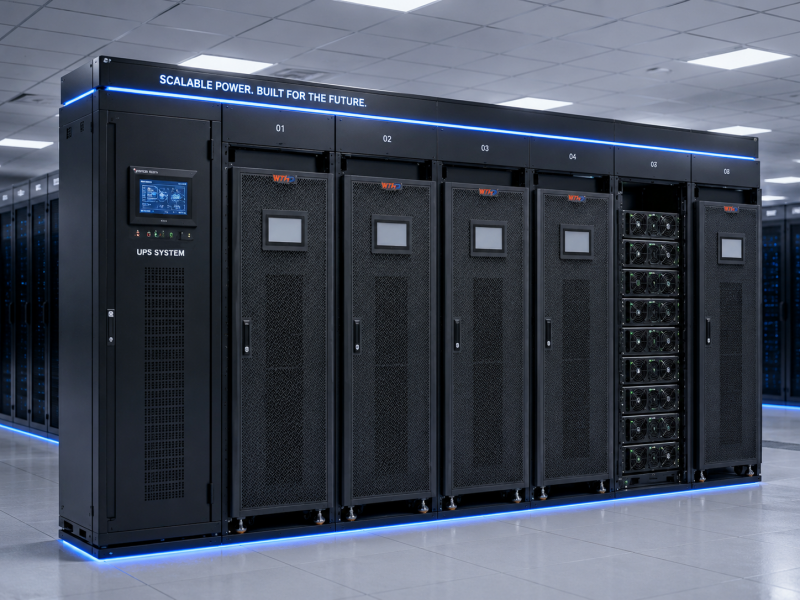
Cost Savings With traditional UPS systems you get what you pay for upfront. When using a scalable UPS system, the savings start with the hardware and continue throughout the life cycle of the equipment. You never need to over buy a massive UPS system that will operate at capacity many years into the future through out use of pay-as-you grow technology.
Besides saving upfront-modular systems also offer significant savings on operating expenses. Traditional UPS systems tend to be most inefficient running at low loads. Because modular systems can be configured-only the needed number of modules can be switched on to meet existing loads and run at optimum efficiency. Substantial energy savings like this have been identified as the driving factor for total cost of ownership. Since each module is hot-swappable, a malfunctioning module can be unplugged, replaced by a good module, and plugged in without taking system offline at all. This eradicates a need for expensive planned-out maintenance and made maintenance cost more economical.
Why Scalable UPS Supports Modern Data Centers and Smart Industries
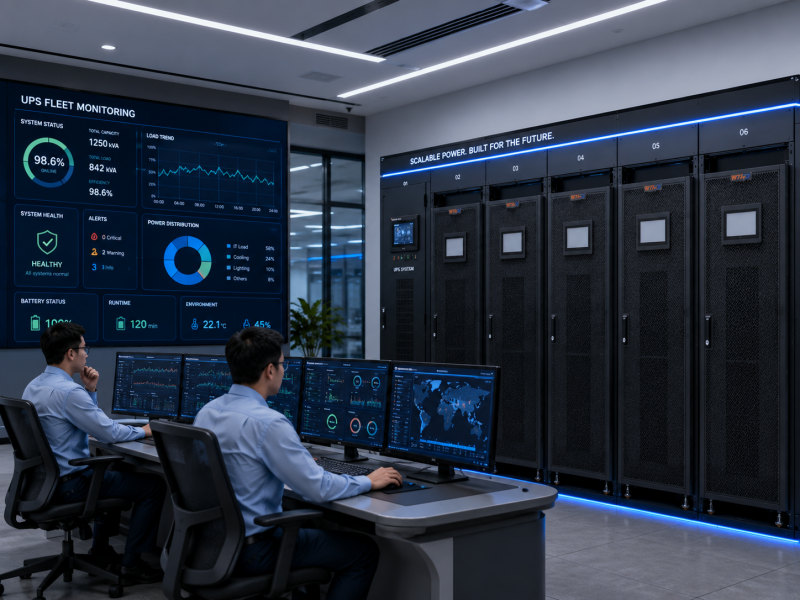
The age of digital is defined by fast pace innovation and high-density computing. Data centers are moving toward sleek, optimized systems requiring intelligent, variable power distribution. Smart industries are adopting IoT, AI, and automation to raise productivity standards and as result imposing highly dynamic and variable power demands for these systems. Either of these areas requires dynamic, always on power protection.
Only scalable UPS systems are specifically built with the capacity for this, their structure allows their to adapt to small installation areas and facilitate the flexible setup required in a typical space-saving contemporary data center layout. For smart industries that have been traditionally seeking only partial high-availability power for critical points of presence, the system is able to rearrange power modules at speed in order to dispatch power where it's needed. An innovative, flexible scalable UPS system provides the foundation of advanced, next-generation smart industry power protection systems, designed to enable revolutionary technology.
So the power protection solution of the future is going to be scalable, fundamentally. As industries continue to evolve and face ever-increasing demand, the necessity to flexibly and efficiently adapt to future power needs is becoming crucial. Scalable UPS systems with flexible expandability and predictable costing are the ideal fit to the evolving business-critical world of smart industry and the digital age.